


Purchase Our Products

Resources
Green-Laser LPBF for a Copper DIMM Liquid Cold Plate: Design, Manufacturing and Project Results
Category:Case Study
Area:copper DIMM cold plate, server memory liquid cooling; green laser copper 3D printing; additively manufactured cold plate; AI data center cooling; pure copper LPBF; DIMM thermal management
Release time:2026-08-17
Last update:2026-08-17
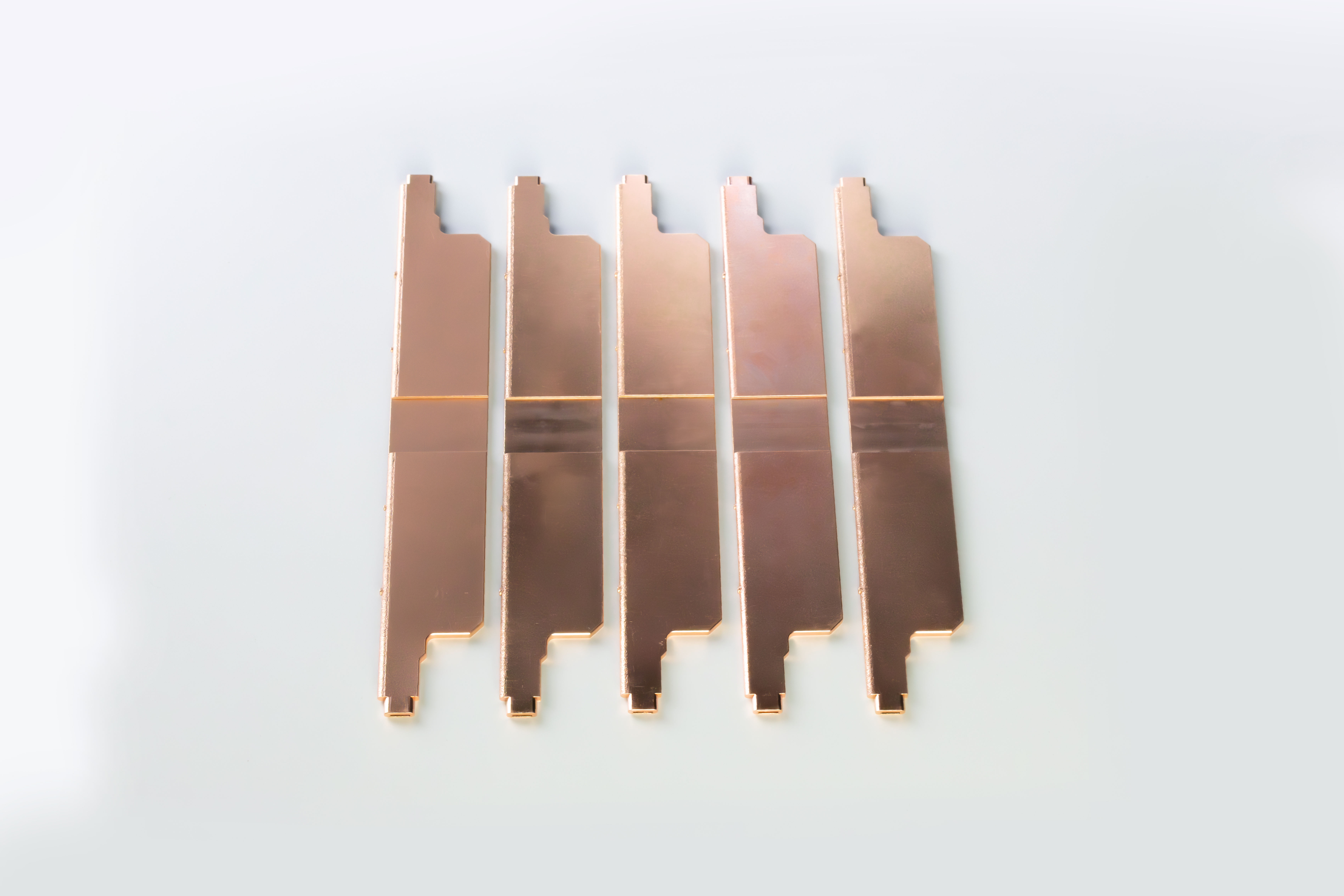
A memory cold plate must fit between closely spaced DIMMs, move heat into the coolant, remain leak-tight and keep its contact surfaces within tolerance. This project used green-laser powder bed fusion to build those functions into a single copper component.
Why server memory is moving closer to the liquid loop
Air cooling remains practical for many memory configurations, but its margin narrows when module power and packing density increase. Closely spaced DIMMs can also develop uneven local temperatures because the available airflow is shared across several modules.
The design problem starts at the memory package
The useful metric is the resistance of the complete route from the heat source to the liquid. That route includes the package, interface material, contact pressure, copper wall and convective boundary inside the channel. For the wall alone, thermal conduction resistance can be approximated by R = t/(kA). Lowering wall thickness t shortens the path, while higher conductivity k and larger effective area A reduce resistance.
Why print the cold plate as one copper part
A machined cold plate usually relies on separate halves or a cover that is later joined to the channel body. Laser powder bed fusion can produce the enclosure and internal passages in the same build. The main benefit is not visual complexity; it is the option to route liquid around a narrow heat-source region without adding another bonded interface.
Density, dimensional variation, machining allowance and sealing surfaces require defined acceptance methods. Additive manufacturing is therefore most useful when integrated geometry solves a packaging or flow problem that would be difficult to achieve with conventional fabrication.
Why a green laser is used for pure copper
Copper conducts heat well but couples poorly with the near-infrared wavelength used by many LPBF systems. A 532 nm green source provides a different absorption condition and can support a more workable melt process. Pure-copper samples can achieve relative density up to 99.9% and electrical conductivity up to 100% IACS. The final outcome still depends on the powder, orientation, scan parameters, geometry and post-processing route used for the part.
What the DIMM cold-plate build reported
Reported item | Project result |
Minimum wall thickness | 0.4 mm |
Peak heat-source temperature | Below 47 °C |
Relative density | Up to 99.9% |
Thermal conductivity | Up to 400 W/(m·K) |
Dimensional accuracy | ±0.1 mm |
Average build time | 0.75 h per part |
The temperature below 47 °C is useful only with its boundary conditions. Heat load, coolant type, inlet temperature, flow rate, pressure drop, contact pressure, interface material and ambient conditions can all change the result.
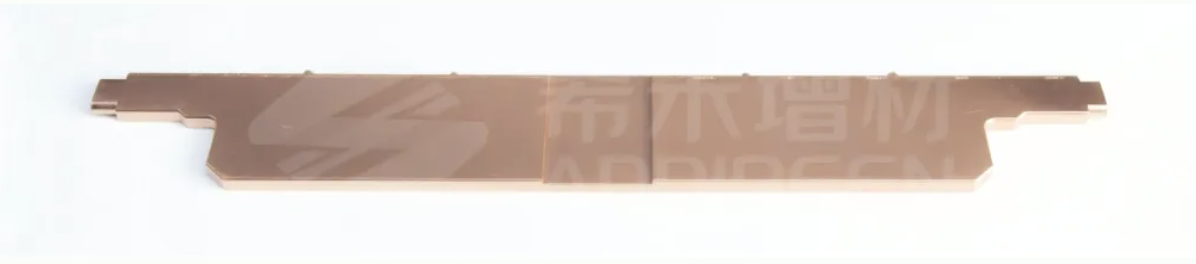
The copper DIMM cold-plate prototype documented in the supplied case material.
What must be controlled after printing
Release to production requires a chain of checks rather than a single density value. Dimensional inspection establishes contact features and port locations. Channel cleaning and internal inspection address residual powder. Leak, proof-pressure and flow tests confirm the fluid path, while thermal cycling examines whether the component remains stable in service.
Post-processing should be specified with the build because it can change the functional geometry. Depowdering, heat treatment, machining and surface finishing may affect channel section, flatness, surface condition and final tolerance. For systems containing dissimilar metals, the plan should also cover coolant chemistry and galvanic-corrosion control.
When this manufacturing route is worth evaluating
A printed copper cold plate is a reasonable candidate when the package is tight, the liquid path must turn around several local heat sources, or part consolidation removes a difficult joint. The same logic can apply to processor cold plates, compact copper heat exchangers, cooled busbars and power-electronics components. Expected volume, inspection access, pressure loss, finishing and delivered cost should remain part of the selection.
Discuss a copper thermal-management component
To review material options and print requirements, visit our Pure Copper 3D Printing material page https://www.addireennow.com/en/pure-copper-cu/82378.html.
For more cold-plate and heat-exchanger examples, see Advanced Thermal Management https://www.addireennow.com/en/industries/advanced-thermal-management/c44da.html.
If you already have a model and operating conditions, use Instant Quote to request a manufacturing assessment https://www.addireennow.com/en/quote.
Looking for 3D Printing Services?
For on-demand manufacturing, part production, and instant quotes, please visit our dedicated Service Bureau platform by clicking the button to the right.
Printing Service
Unlock Green Laser Metal AM: Your Partner for Equipment & Services
Business Cooperation & Equipment Inquiries
Interested in acquiring our Green Laser AM systems or exploring partnership opportunities? Please fill out the form below, and our sales team will contact you shortly.
I confirm that I accept the Privacy Policy.



Subscribe
Sign up for product updates and promotions!
I agree to receive industry news, product and service promotions, and all other relevant Addireen communications.


Contact Us
Shenzhen Addireen Technologies Co., Ltd.
Building 7, Detai Technology Park, Dalang Street, Longhua District, Shenzhen, Guangdong, China.
(+86) 193-5719-8013
Copyright © 2026 Addireen. All Rights Reserved | 粤ICP备2024303078号-1