


Purchase Our Products

Resources
Green Laser 3D Printing for Production-Ready Pure Copper Cold Plates
Category:Case Study
Area:
Release time:2026-07-23
Last update:2026-09-04
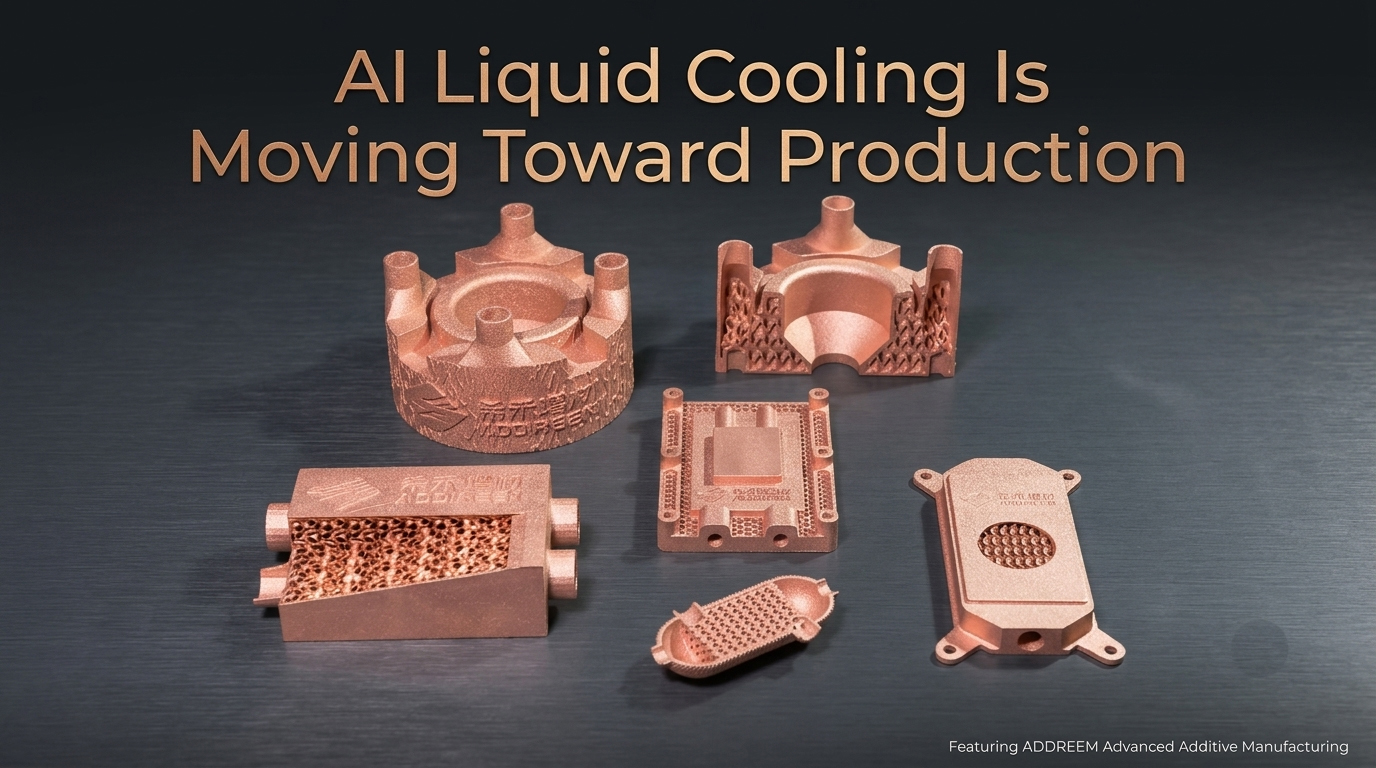
AI data centers are changing the requirements for thermal management. As chip power and rack power density continue to rise, cooling hardware is being pushed beyond the limits of conventional air cooling and standard liquid cooling designs.
The question is no longer whether liquid cooling can work. In many AI server applications, it is already becoming necessary. The more difficult question is whether critical components, such as pure copper cold plates and microchannel heat exchangers, can be produced with the precision, repeatability, and throughput required for real deployment.
Industry forecasts point in the same direction. TrendForce projects that liquid cooling adoption for AI chips could reach 47% in 2026, as TDP moves from about 700 W for NVIDIA H100/H200 toward 1,000 W and above for B200/B300-class platforms. Grand View Research also estimates that the data center liquid cooling market will grow from USD 8.2 billion in 2026 to USD 29.5 billion by 2033. For thermal engineers and supply-chain teams, this means manufacturability is now part of the design problem.
Why Pure Copper Cold Plates Are Hard to Scale
Pure copper is a natural choice for high-performance cooling parts. It offers thermal conductivity up to about 400 W/mK and can support designs that need both heat transfer and electrical conductivity. This is why copper is widely considered for liquid cold plates, induction coils, heat exchangers, power electronics cooling, and optical module heat sinks.
The challenge is processing.
In conventional laser powder bed fusion systems using near-infrared lasers around 1,064-1,070 nm, pure copper absorbs only a small fraction of the laser energy. Published studies commonly report very low absorptivity at infrared wavelengths, often around or below 5% for solid copper surfaces. Most of the energy is reflected. At the same time, the energy that is absorbed spreads quickly because copper conducts heat so efficiently.
This combination makes the melt pool harder to control. It can increase the risk of lack-of-fusion defects, porosity, spatter, and unstable layer-to-layer quality. For a simple demonstration part, that may be manageable. For an AI liquid cooling cold plate with thin walls, microchannels, and pressure-drop requirements, it becomes a production risk.
Conventional manufacturing has its own limits. Brazed or assembled cold plates can introduce joints and sealing interfaces. Machining is reliable for many geometries, but it restricts internal channel design. As thermal simulation pushes designs toward more compact, higher-surface-area structures, the gap between the optimized design and the manufacturable part becomes more visible.
What Green Laser 3D Printing Changes
Green laser 3D printing addresses copper processing at the laser-material interaction level. At a wavelength near 532 nm, copper absorbs significantly more laser energy than it does under infrared irradiation. Public studies and industry data commonly report copper absorption at green wavelengths in the range of roughly 40%, depending on surface state, temperature, and process conditions.
For copper LPBF, higher absorption improves energy coupling into the powder bed. This helps stabilize melting behavior and supports denser, more repeatable copper parts.
In Addireen's green laser copper process, printed pure copper parts can reach up to 99.9% density, thermal conductivity up to 400 W/mK, and electrical conductivity of about 101% IACS. Fine copper features, including wall thickness down to 0.1 mm, can also be produced under suitable process conditions.
These numbers matter because the goal is not simply to print copper. The goal is to build functional thermal structures: microchannels, thin fins, heat-transfer surfaces, and integrated flow paths that can move from prototype testing into controlled batch production.
Design Freedom Has to Be Matched by Manufacturing Control
Green laser LPBF allows thermal components to be built as one continuous metal part. For liquid cooling, this opens the door to internal channels, high-density fin structures, non-planar flow paths, and TPMS-based heat exchange geometries.
For engineering teams, this changes the design workflow. Instead of simplifying a cooling channel to match machining access or brazing constraints, the structure can be developed around heat flux distribution, pressure-drop targets, powder removal, inspection access, and printability.
Monolithic construction also reduces several common risk points. A one-piece pure copper cold plate removes brazed joints from the internal flow path and reduces the number of sealing interfaces. It may also reduce contact thermal resistance compared with assembled structures.
That does not mean every 3D printed cold plate will automatically perform better. The benefit depends on the full engineering workflow: simulation, design for additive manufacturing, printing, powder removal, post-processing, inspection, and thermal testing. When these steps are treated together, green laser copper 3D printing can make previously difficult thermal designs more practical.
From Prototype Parts to Repeatable Production
For AI data center cooling, consistency is often the harder problem. A cold plate must meet dimensional requirements, keep pressure drop within the expected range, pass leakage testing, and remain repeatable from build to build.
This is where equipment capability and process control become important.
Addireen's dual green-laser metal 3D printer is developed for pure copper and copper alloy production. The system uses 2 × 500 W continuous single-mode green fiber lasers at 532 nm, supporting stable copper manufacturing beyond one-off prototyping.
For production-oriented copper thermal components, the manufacturing loop usually includes:
1. Define heat flux, flow rate, and pressure-drop requirements.
2. Develop internal channels through thermal and fluid simulation.
3. Review printability, wall thickness, support strategy, powder removal, and inspection access.
4. Print and test prototype parts.
5. Adjust geometry and process parameters.
6. Move the validated design into controlled batch production.
This workflow takes more effort than printing a showcase part, but it is the part that matters for AI infrastructure. Cooling components used in data centers need to be measurable, repeatable, and serviceable.
Why This Matters for AI Data Center Cooling
AI liquid cooling is moving from early validation into production planning. As that happens, pure copper liquid cold plates and microchannel heat exchangers need to meet a more complete set of requirements: high conductivity, compact geometry, controlled internal flow, stable pressure drop, and repeatable manufacturing quality.
Green laser 3D printing provides a practical route because it improves copper absorption during processing and expands the design space for internal cooling structures. Its value is strongest when material processing, thermal design, printability review, inspection, and production control are connected from the beginning.
For teams evaluating next-generation AI cooling hardware, the next step is not just to ask whether copper can be printed. It is to ask whether the chosen process can support the performance, consistency, and production requirements of the final cooling component.
Learn more:
Advanced thermal management solutions: https://www.addireennow.com/en/industries/advanced-thermal-management/c44da
Green laser copper thermal management white paper: https://www.addireennow.com/en/green-laser-copper-thermal-management/ad64d
Online quote platform: https://www.addireennow.com/en
Looking for 3D Printing Services?
For on-demand manufacturing, part production, and instant quotes, please visit our dedicated Service Bureau platform by clicking the button to the right.
Printing Service
Unlock Green Laser Metal AM: Your Partner for Equipment & Services
Business Cooperation & Equipment Inquiries
Interested in acquiring our Green Laser AM systems or exploring partnership opportunities? Please fill out the form below, and our sales team will contact you shortly.
I confirm that I accept the Privacy Policy.



Subscribe
Sign up for product updates and promotions!
I agree to receive industry news, product and service promotions, and all other relevant Addireen communications.


Contact Us
Shenzhen Addireen Technologies Co., Ltd.
Building 7, Detai Technology Park, Dalang Street, Longhua District, Shenzhen, Guangdong, China.
(+86) 193-5719-8013
Copyright © 2026 Addireen. All Rights Reserved | 粤ICP备2024303078号-1