


Purchase Our Products

Resources
Critical Path to Enhancing IGBT Thermal Performance: A Technical Analysis of Structural Optimization
Category:Case Study
Area:IGBT; Advanced Thermal Management ;
Release time:2026-03-06
Last update:2026-05-14
In the rapid development of New Energy Vehicles (NEVs), the IGBT power module plays a pivotal role in the energy conversion of electric drive systems, with its reliability directly linked to vehicle safety and performance. However, both industry experience and academic research repeatedly point out that the true "invisible killer" of power modules is not electrical issues, but thermal stress fatigue induced by high temperatures and temperature cycling. This thermal fatigue eventually manifests as failure modes like solder layer cracking and bond wire liftoff, which are the root causes of shortened lifespans for the vast majority of power modules. As electric drive systems continue to evolve toward higher power densities, traditional cooling methods can no longer meet demand, making the Pin-Fin liquid cooling scheme the mainstream choice for current automotive-grade power modules.
The dominance of Pin-Fin structures in automotive-grade modules is well-founded. First, they significantly expand the heat exchange surface area within a limited volume, improving convective heat transfer efficiency. Second, they reduce thermal resistance and shorten the heat conduction path, effectively controlling peak chip temperatures. Third, the structure possesses excellent scalability, capable of working synergistically with double-sided cooling to meet rising heat flux density requirements. Notably, the geometry of the Pin-Fin has a profound impact on both cooling effects and flow resistance. From cylinders and teardrops to elliptical structures, every design represents a distinct direction in engineering optimization.
Traditional manufacturing processes, constrained by tooling and machining paths, struggle to form high-density, complex thermal structures on metal materials. Additive Manufacturing (AM) steps in to break this bottleneck. Through layer-by-layer construction, AM not only enables smaller fin spacing and more diverse geometric shapes but also allows for the creation of 3D interlaced flow channels and intricate micro-structures impossible with traditional methods. This provides unprecedented freedom for heatsink structural optimization and forms the technical foundation of Addireen’s competitive advantage in the field of power module thermal substrates.
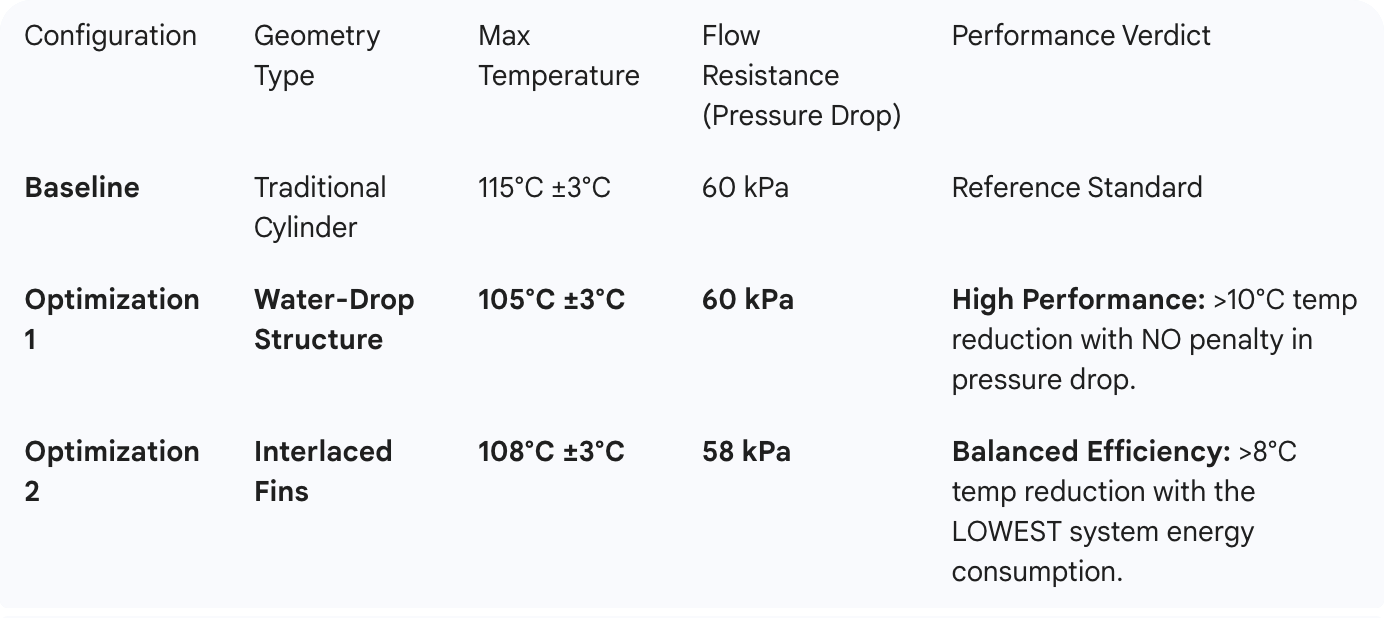
To break through the thermal bottlenecks of power modules, Addireen partnered with a globally renowned thermal device manufacturer to conduct joint research addressing insufficient liquid cold plate performance, utilizing Pure Copper 3D Printing technology to achieve high-performance heatsink products. Leveraging Addireen’s proprietary Green Laser Pure Copper 3D Printing equipment, combined with the high design freedom granted by AM and the advanced capabilities of the design team, three configurations of power module heatsinks were fabricated. (Note: Specific design details are not displayed due to confidentiality).
From the data, we can clearly observe the differences in thermal performance across the three configurations:
The Baseline Configuration (using a common cylindrical structure) reached a maximum temperature of 115°C ±3°C with a flow resistance of 60 kPa.
Optimization Configuration 1 ("Teardrop Structure"), under the same coolant flow rate and design domain dimensions, reduced the maximum temperature to 105°C ±3°C. This represents an improvement of over 10°C while maintaining the same flow resistance. This demonstrates that by altering the configuration, size, spacing, and arrangement of thermal features, it is possible to significantly enhance heat transfer performance without increasing flow resistance.
Upon introducing an interlaced fin structure, Optimization Configuration 2 achieved a maximum temperature of 108°C ±3°C (a reduction of over 8°C) but with flow resistance lowered to 58 kPa—the lowest among the three schemes. The "Temperature Optimization + Reduced Flow Resistance" combination exhibited by Optimization Configuration 2 makes it a more balanced design, particularly suitable for scenarios sensitive to whole-vehicle energy consumption.
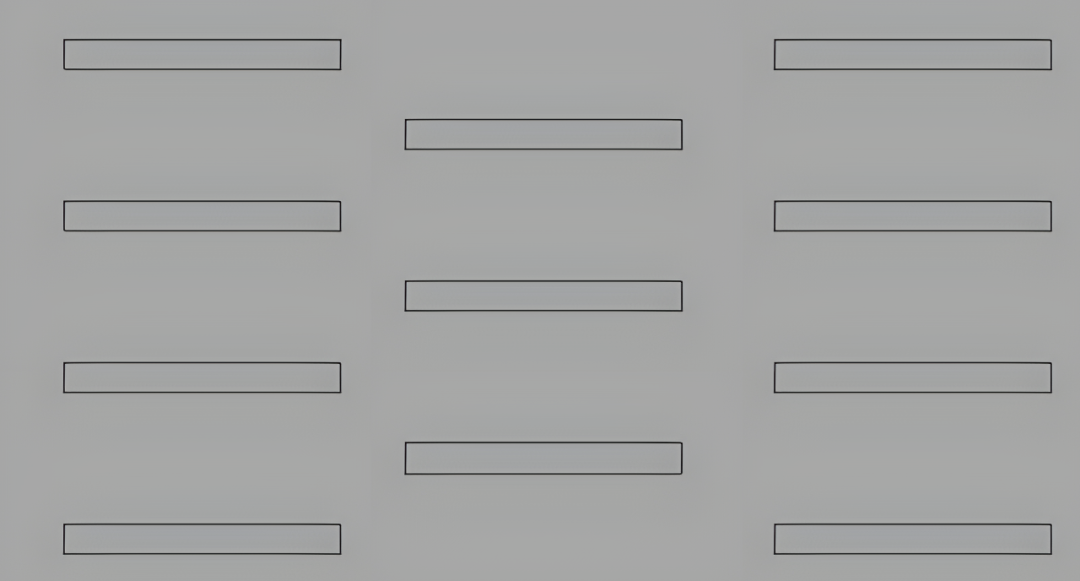
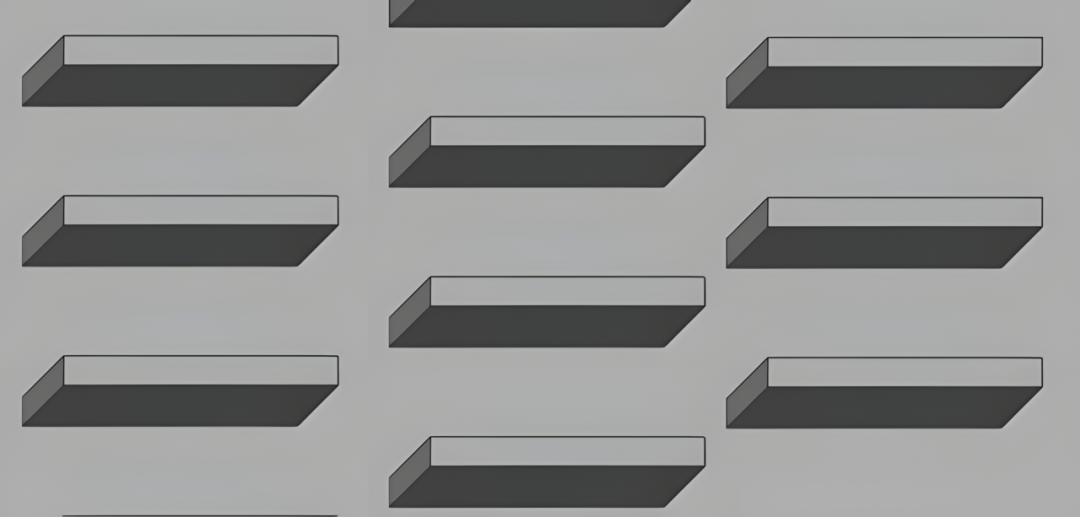
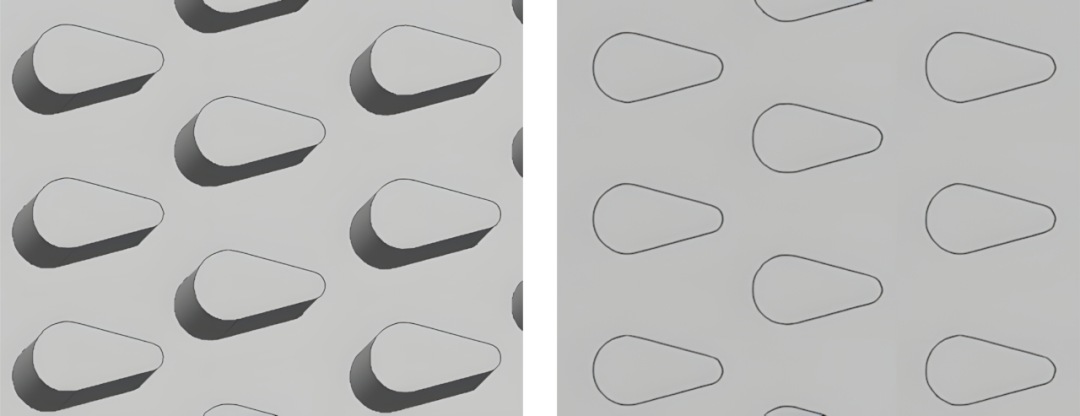
From a mechanistic perspective, teardrop-shaped structures offer superior drag reduction effects. Under the same flow resistance conditions, this allows for the arrangement of more units, thereby enhancing heat transfer. Furthermore, AM enables the fabrication of smaller-scale teardrop structures and tighter spacing, effectively increasing the heat exchange surface area. Enhanced thermal performance implies not only lower temperatures but, more importantly, a direct positive impact on the lifespan of the power module. Further research and validation for this project are ongoing.
In conclusion, liquid cooling schemes based on Pin-Fin and similar structures will remain the core technical route for future automotive-grade module thermal management. However, the design freedom brought by Additive Manufacturing is propelling this structure from "Manufacturable" to "Optimizable." Addireen’s optimized configurations demonstrate the engineering value of AM in thermal enhancement through quantifiable data: achieving significant temperature improvements while simultaneously lowering system-level flow resistance and boosting liquid cooling efficiency.
Looking for 3D Printing Services?
For on-demand manufacturing, part production, and instant quotes, please visit our dedicated Service Bureau platform by clicking the button to the right.
Printing Service
Unlock Green Laser Metal AM: Your Partner for Equipment & Services
Business Cooperation & Equipment Inquiries
Interested in acquiring our Green Laser AM systems or exploring partnership opportunities? Please fill out the form below, and our sales team will contact you shortly.
I confirm that I accept the Privacy Policy.



Subscribe
Sign up for product updates and promotions!
I agree to receive industry news, product and service promotions, and all other relevant Addireen communications.


Contact Us
Shenzhen Addireen Technologies Co., Ltd.
Building 7, Detai Technology Park, Dalang Street, Longhua District, Shenzhen, Guangdong, China.
(+86) 193-5719-8013
Copyright © 2026 Addireen. All Rights Reserved | 粤ICP备2024303078号-1