


Purchase Our Products

Resources
Overcoming Thermal Bottlenecks in Optical Transceivers with Pure Copper 3D Printing
Category:Technology
Area:1.6T / 3.2T optical transceiver thermal management, LPO / CPO cooling architectures, 3D printed transceiver housing
Release time:2026-06-09
Last update:2026-09-04
The Thermal Challenge in Optical Transceivers
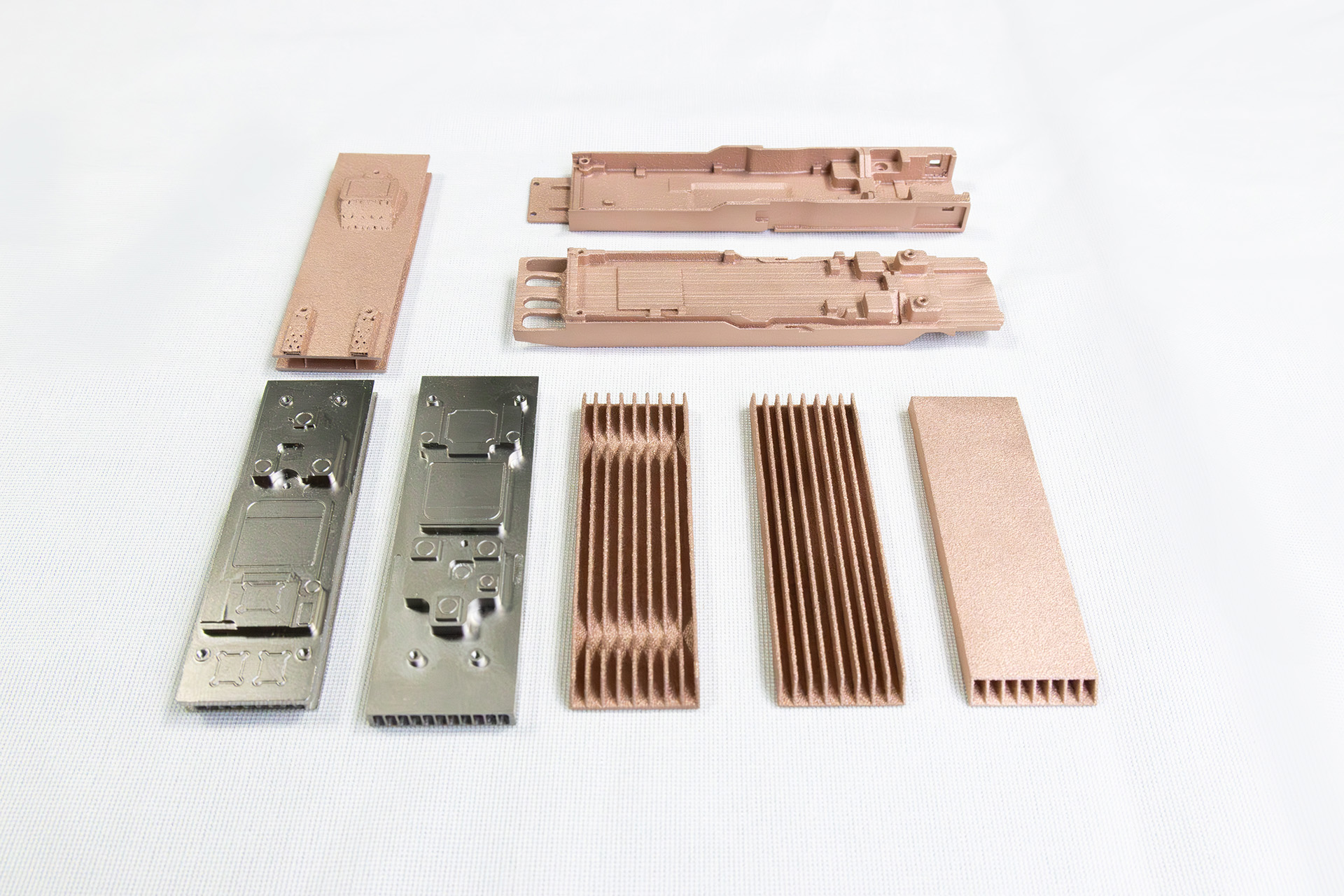
Optical transceivers convert electrical signals into optical signals for high-speed, long-distance data transmission in modern data centers. Every piece of data in an AI cluster passes through these modules. As thermal demands increase, Addireen utilizes green-laser pure copper 3D printing to create monolithic transceiver housings with integrated fin structures. This approach reduces junction temperatures within standard form factors, providing essential thermal management for next-generation modules.
Bandwidth Scaling and Heat Dissipation
The computing requirements for large model training double every three to four months. Interconnecting massive GPU clusters requires a volume of optical transceivers that often exceeds the number of GPUs. Bandwidth scaling is accelerating: 1.6T transceivers will reach broad market availability in 2026, while 3.2T modules are actively being developed by manufacturers like Lumentum, InnoLight, Coherent, and Eoptolink.
However, higher data rates increase power dissipation. While a 400G module consumes approximately 10W, 1.6T modules are projected to exceed 20W, and 3.2T modules could reach 40–50W without architectural changes. Even highly efficient designs, such as Lumentum's 21W 3.2T silicon photonics NPO module, face extreme local heat flux due to high integration density. Addireen addresses this by integrating the transceiver shell and staggered short-fin arrays into a single pure copper 3D-printed component, meeting these thermal requirements without altering standard mechanical envelopes.
Form Factor Constraints and Architectural Shifts
Optical transceivers must adhere to standardized form factors like QSFP-DD and OSFP, restricting volumetric expansion. Consequently, heat flux per unit area doubles between hardware generations. For 1.6T modules and beyond, external forced-air cooling is insufficient; improvements must focus on the module's intrinsic thermal conductivity and housing design.
Furthermore, the shift toward Linear-drive Pluggable Optics (LPO) and Co-Packaged Optics (CPO) concentrates heat sources as optical engines move closer to switch ASICs. Localized temperature spikes can cause wavelength drift, degrade signal integrity, and reduce component lifespan. As geometric space shrinks, the bulk thermal conductivity of the material becomes the primary factor in cooling performance.
Material and Manufacturing Innovations
Pure copper offers a thermal conductivity of 400 W/(m·K)—nearly double that of tungsten-copper and over 20 times that of Kovar. Transitioning to a pure copper housing reduces junction-to-case thermal resistance by roughly 50%, which lowers the chip junction temperature by 5–10°C.
Manufacturing pure copper via traditional near-infrared lasers is inefficient, as the metal absorbs less than 5% of the energy, leading to high porosity and unstable melt pools. Addireen utilizes a 532nm green laser, which significantly increases absorption rates in highly reflective metals. This ensures a stable melt pool, higher build density, and has established green lasers as the standard for copper additive manufacturing.
Core Technical Capabilities
Addireen’s green-laser powder bed fusion process achieves three primary breakthroughs:
Processing Highly Reflective Metals: It overcomes traditional limitations in manufacturing pure copper, specifically its high reflectivity, high thermal conductivity, and oxidation sensitivity.
Complex Internal Geometry: The process enables the monolithic fabrication of structures impossible to achieve via conventional machining, such as conformal cooling channels, ultra-thin fins, and staggered short-fin arrays.
High Precision: With a minimum focused spot diameter of 15μm, the technology ensures precise feature resolution and high part density.
Rather than simply substituting materials, this method structurally redesigns the housing. By embedding staggered short-fin arrays directly into the pure copper shell, local thermal performance is maximized. Physical testing confirms this approach lowers operating temperatures within standard dimensions, ensuring the signal stability required for 1.6T and higher-speed transceivers.
Scalability and Industry Impact
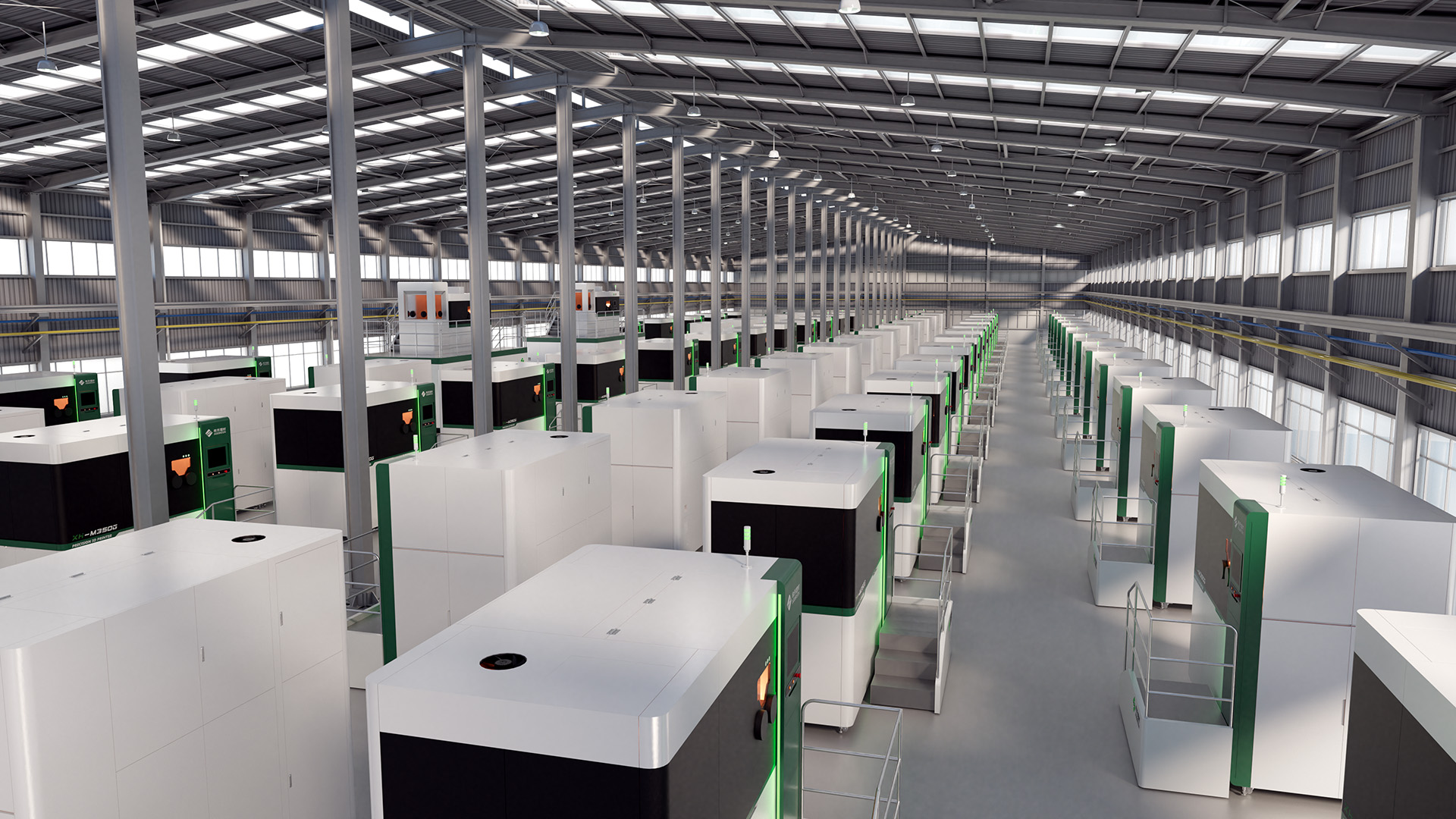
This solution is currently in industrial production, with over 100 green-laser additive manufacturing systems in operation. Addireen plans to expand this to over 1,000 systems within three years, establishing a large-scale copper additive manufacturing base.
By combining high-conductivity pure copper with complex internal heat transfer structures, green-laser 3D printing transitions the transceiver housing from a passive shell to an active thermal management component. It meets the thermal demands of next-generation optical modules without requiring changes to assembly dimensions, custom tooling, or supply chain redesigns.
Looking for 3D Printing Services?
For on-demand manufacturing, part production, and instant quotes, please visit our dedicated Service Bureau platform by clicking the button to the right.
Printing Service
Unlock Green Laser Metal AM: Your Partner for Equipment & Services
Business Cooperation & Equipment Inquiries
Interested in acquiring our Green Laser AM systems or exploring partnership opportunities? Please fill out the form below, and our sales team will contact you shortly.
I confirm that I accept the Privacy Policy.



Subscribe
Sign up for product updates and promotions!
I agree to receive industry news, product and service promotions, and all other relevant Addireen communications.


Contact Us
Shenzhen Addireen Technologies Co., Ltd.
Building 7, Detai Technology Park, Dalang Street, Longhua District, Shenzhen, Guangdong, China.
(+86) 193-5719-8013
Copyright © 2026 Addireen. All Rights Reserved | 粤ICP备2024303078号-1